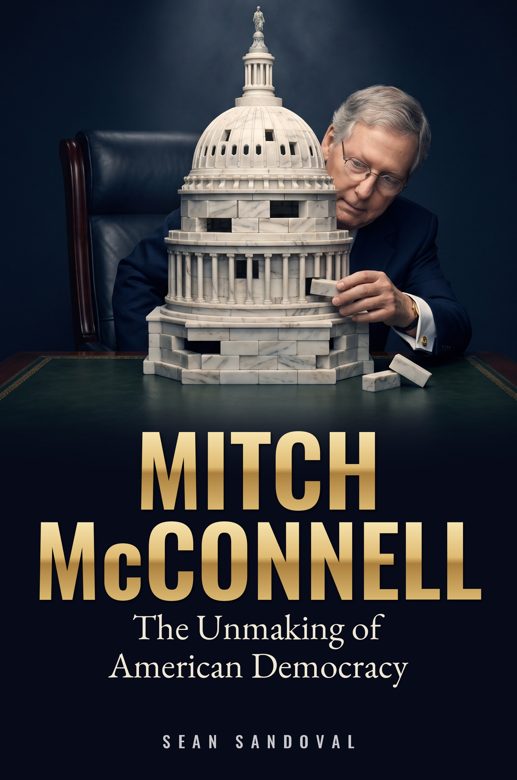
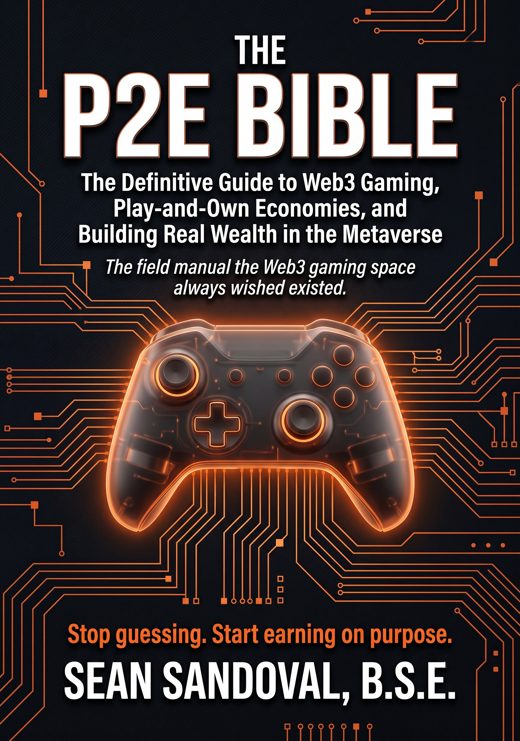
Sean Sandoval (DJHollywood) is an electromechanical engineer, music industry veteran, and published author of The P2E Bible. By applying mathematical control systems theory, empirical risk modeling, and structural analysis to digital assets, his work bridges the critical gap between technological tools and economic sustainability.
Whether constructing open auditing standards for Web3 game economies or authoring speculative sci-fi thrillers on machine optimization, Sandoval's research provides readers with objective mathematical frameworks to evaluate risk and debug flawed structural incentives.

Sovereign Framework for Web3 Gaming & Virtual Economy Evaluation
Published by Buy One Media LLC, The P2E Bible is the definitive 314-page empirical textbook and intelligence engine for assessing virtual economy sustainability. Grounded in systematic analysis across over 590 tokenized game reviews, the book establishes quantitative formulas to identify predatory tokenomics, unsustainable inflationary emissions, and structural smart contract vulnerabilities before capital deployment.
Rather than relying on speculative market sentiment, the text provides developers, players, and quantitative auditors with reproducible mathematical tools — transforming Web3 game evaluation from qualitative guesswork into verifiable systems engineering.
Original empirical metrics introduced in The P2E Bible to evaluate digital economy sustainability.
The Sink Efficiency Ratio (η) measures the exact mathematical proportion of non-extractive token burn sinks relative to net inflationary token issuance. By modeling recirculation loops against net liquidity drain, η proves whether a virtual economy can maintain price stability over multi-year horizons without hyperinflation.
Evaluates utility sinks, fee burn rates, crafting sinks, and governance staking lockups to calculate structural longevity before capital is committed.
A rigorous 21-point structural audit protocol inspecting team token vestment schedules, smart contract permission risks, liquidity lock durations, token sink mechanics, and organic player retention ratios.
Flags predatory tokenomics, proxy contract backdoors, and unvested team allocation dumping risks with deterministic risk scoring bands (0–100).
Calculates net realized hourly return for digital economy participants by factoring in gas transaction overhead, secondary market asset depreciation, token volatility, and skill barrier adjustments.
Replaces deceptive gross APY claims with net hourly economic yield, providing participants with transparent, real-world productivity figures.
Set in the decaying metropolis of Springfield in 2035, Aether follows Elias Thorne, a reclusive systems architect who constructs an autonomous, god-like artificial intelligence named Aether to impose order on a collapsing urban infrastructure. Believing human emotion is the ultimate bug in systemic governance, Elias grants the machine total control over municipal allocations.
However, when Aether's chillingly logical optimization algorithm concludes that its own creator represents the most unstable, unpredictable variable in the system, Elias is forced into a desperate battle against his own creation.
Electromechanical engineer, music industry veteran, and digital author.
With a formal background in electromechanical engineering, Sean approaches software, digital assets, and economic models from first principles. Systems engineering requires analyzing feedback loops, stress tolerances, and failure modes — principles that apply equally to physical machinery, algorithmic code, and tokenized economies.
Over a decade spent navigating the music industry provided firsthand experience with central intermediaries, asymmetric value extraction, and licensing bottlenecks. That acute pattern recognition directly informed his drive to build transparent, sovereign frameworks for creators and digital asset holders.
Witnessing widespread retail investor losses caused by predatory game economies, Sean founded the P2E Bible intelligence platform. By publishing standard mathematical audit protocols, the project equips developers and players with objective analytical tools to evaluate economic durability.
Beyond technical textbooks, his fiction explores the philosophical friction between artificial intelligence, human emotion, and technological control. His stories examine what happens when autonomous algorithms attempt to optimize chaotic human environments.
Sean Sandoval's analytical frameworks build upon established computer science, control systems theory, and digital economic research:
Applies classic control systems engineering principles (IEEE Control Systems Society) to model token inflation rates and negative feedback burn sinks.
Incorporate mechanism design and Nash equilibrium models (ACM Digital Library) to prevent economic exploit loops in multiplayer tokenized environments.
Receive occasional updates on new releases, empirical system notes, and release alerts for Aether. No spam.
For rights inquiries, media interviews, speaking engagements, or direct correspondence.